We took our crash game — the actual WASM binary that runs on-chain — and ran 5 million rounds through it, four times with different RNG seeds. One bot. One strategy: always cash out at 5x.
Not a spreadsheet model. Not theoretical math. The real game engine, the real RNG derivation, the real settlement logic. Here's what the math looks like when you stop guessing and start measuring.
The Rules
Crash is simple. A multiplier starts at 1.0x and climbs 3.5% per tick (~500ms). At some random point, it crashes to zero. Cash out before the crash, you win. Miss it, you lose your stake.
The house edge is 2% — a parameter baked into the WASM game binary. It means 2% of every dollar wagered flows to the house over time. Not more, not less. The math enforces it.
Our bot targets 5x every round. No emotion. No “feeling lucky.” Just 5x, every time, for 5 million rounds.
Half of All Rounds Die Before 2x
The crash point follows an inverse distribution. Most rounds die fast:
| Crash before | % of rounds | What it means |
|---|---|---|
| 1.0x | 2% | Instant crash. Everyone loses. |
| 1.5x | 35% | One in three rounds dies here |
| 2.0x | 51% | More than half of all rounds |
| 5.0x | 80% | Our bot loses 4 out of 5 |
| 10x | 90% | 1 in 10 survive |
| 100x | 99% | The moonshot is real but rare |
| 1,000x | 99.9% | Once in a thousand |
The median crash point is 1.96x. If your strategy targets anything above 2x, you're losing more often than winning.
But You CAN Win
We measured the house edge in 20,000-round windows — roughly one week of live play on a single crash table.
The swings are massive:
That's a 9.92 percentage point swing in a single week. This is variance — the mathematical reality of a high-multiplier game.
At 5x target, the bot wins roughly 1 in 5 rounds. But wins pay 5x. When you hit a streak of 3–4 wins in a short window, you're up big. That streak is mathematically expected.
...But the House Always Wins
Cumulative house edge over 5 million rounds — four independent RNG seeds, four different paths. All converge to 2%.
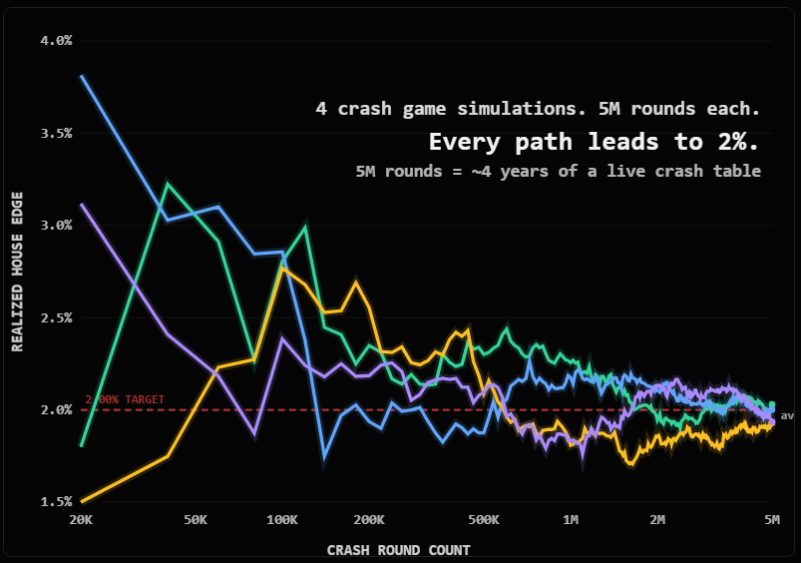
| Rounds | Time equivalent | Edge range (4 seeds) |
|---|---|---|
| 20,000 | ~6 days | 0.70% — 3.81% |
| 100,000 | ~1 month | 2.38% — 2.86% |
| 500,000 | ~5 months | 1.88% — 2.30% |
| 1,000,000 | ~10 months | 1.81% — 2.26% |
| 2,000,000 | ~1.5 years | 1.85% — 2.13% |
| 3,000,000 | ~2.5 years | 1.85% — 2.10% |
| 4,000,000 | ~3 years | 1.92% — 2.08% |
| 5,000,000 | ~4 years | 1.93% — 2.03% |
At 3,500 rounds per day on a single crash table, 5 million rounds is ~4 years of continuous play.
The swings get smaller. The line gets flatter. It converges to one number: 2.00%.
No strategy changes this. The 5x bot, a 1.5x bot, a 100x bot — they all converge to the same 2% house edge.
What This Actually Proves
Every number in this article was generated by running the actual WASM game binary — the same 38KB file deployed on the ExoHash blockchain. Same RNG derivation. Same settlement logic. Same everything.
The randomness comes from BLS threshold signatures produced by the validator set during consensus. No server seed. No oracle callback. No single party can know the outcome before the block finalizes.
The house edge isn't a promise on a website. It's math — verified across 20 million total rounds (4 seeds × 5M), enforced by protocol, and open for anyone to reproduce.
You don't have to trust us. Verify it yourself.
EXOHASH GAME SDK →